License negotiation
Negotiating a technology license
License negotiation is the contracting process that formalizes the transfer of technology or secret know-how to a company (either an existing company or a startup).
A license agreement grants rights to exploit a technology within a defined scope (territory, field of use, exclusivity /non-exclusivity, financial terms, duration, etc.).
Why a license?
Intellectual property originating from a research laboratory cannot be commercially exploited without a license. Therefore, a license is a powerful and essential legal instrument for bringing products and services based on technology or secret know-how to market, as well as for enabling the company to avoid infringing on the rights of the supervising institution ("tutelle"). A preliminary version of a license agreement is often referred to as a "Term Sheet". This is a short document summarizing the main terms agreed upon following an initial round of negotiations between the company and the Technology Transfer Office (TTO). This document does not constitute a binding or irrevocable commitment.
For startups
In the specific case of startups created around licensed technology, the license enables the company to develop its business and has a significant impact on its value potential. It is a central consideration and area of focus for both TTOs and current and future investors. Given the importance of license negotiations to the company's business project, it is essential that future CEOs be well prepared to handle them. This is a genuine commercial negotiation that varies depending on the business activity, the technology being licensed, the business model, and the development potential of each startup being created.
What does a license look like?
Find an example of a license with explanations in French here: Explained license from an educational resource developed by the Réseau C.U.R.I.E. and the Careel law firm.
Note: This document is provided for informational purposes only and is not intended to serve as legal advice or a legal reference document.
Note: This document is provided for informational purposes only and is not intended to serve as legal advice or a legal reference document.
What are the different financial mechanisms for compensating technology transfer?
- Upfront payment: A lump-sum payment made upon execution of the license agreement, which may be converted in whole or in part into an equity investment (directly or through mechanisms such as convertible notes).
- Equity stake in the startup: It is common for the technology transfer or commercialization organization to receive an equity stake in the startup in exchange for the technology transfer. This equity stake may also be provided in exchange for participation in an incubation program or support services related to the creation of the startup.
- Milestones: The payment is divided into several fixed amounts that are released and paid when the startup achieves certain milestones (fundraising, completion of a technical or regulatory development phase, market launch, achievement of a specified revenue level, etc.).
- Royalties: The term "royalties" is also used in the context of negotiations. It refers to recurring payments, generally made annually, based on a percentage of net sales generated using the technology (the rate depends on the relevant industry sector).
- Minimum payments: A minimum amount is established that must be paid as compensation for use of the licensed technology, regardless of whether or not the startup successfully develops its business.
- Intellectual property costs: In addition to license fees, it is common practice in these negotiations to require the startup to cover intellectual property costs (for example, the preparation, prosecution, maintenance, and extension of patents). It should be noted that it may be difficult for a startup to bear these costs from the outset of its operations. The agreement may therefore provide that these costs are initially covered by another party and subsequently reimbursed following the startup's first fundraising rounds.
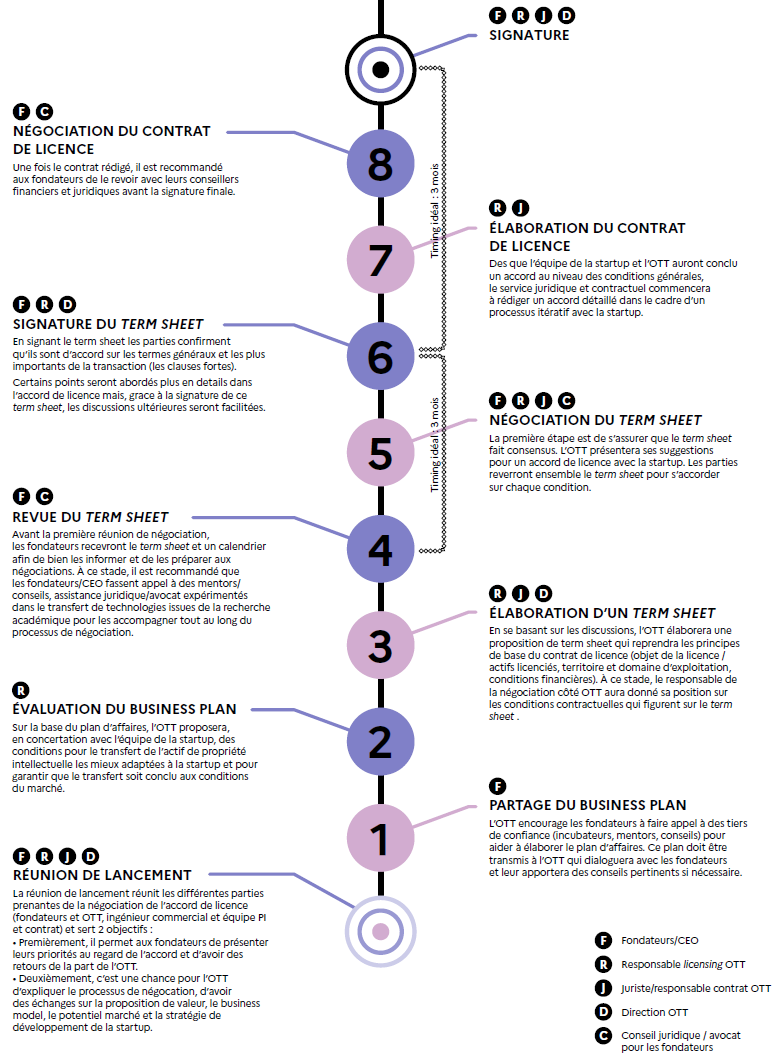
What are the steps in a license negotiation?
How should you prepare?
Download the best practices guide for license negotiation!
This guide, published by the French Ministry responsible for Higher Education and Research, is intended as a first step toward facilitating the transfer of research results to the economic sector by establishing a clear, fair, and understandable framework. It is part of a broader effort to promote transparency and education, with the aim of fostering constructive dialogue among researchers, institutions, technology transfer stakeholders, and investors, and encouraging the emergence of high-impact innovations.
In particular, on page 14, you will find an overview of the typical ranges of financial terms for technology licensing agreements. These ranges are the result of consultations with universities and National Research Organizations (ONRs), their commercialization subsidiaries, and deep-tech investors, with the aim of providing a structured and balanced framework for license negotiations.